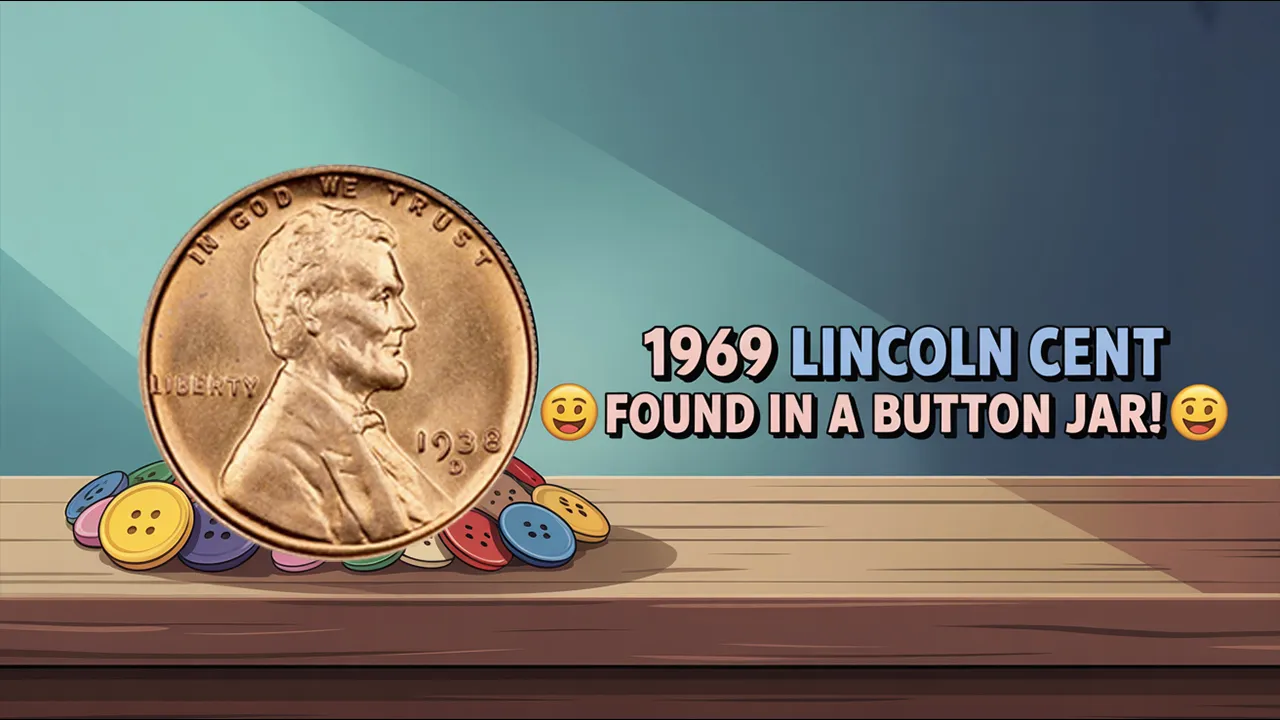
In a small town in the Midwest, a simple jar of old buttons recently became the center of a surprising discovery. What looked like an ordinary 1969 Lincoln Cent turned out to be a rare error coin—one that has fascinated collectors and sparked conversations across social media. The story has quickly gone viral, mainly because it shows how unexpected finds can still happen in everyday American homes.
The coin was discovered when a family was sorting through a box of sewing supplies that once belonged to their grandmother. Inside the jar were colorful buttons, faded threads, and at the bottom, a copper-colored penny from 1969. The family did not think much of it until they noticed something unusual about the coin’s appearance.
What followed was a chain of events that turned a forgotten household item into a headline-worthy discovery.
A Coin That Didn’t Look Quite Right
At first glance, the 1969 Lincoln Cent appeared slightly off—its surface had an unusual strike pattern, and parts of the design seemed shifted. The family decided to look closer, comparing it with other pennies from the same jar. That’s when they noticed the misalignment.
Collectors call this an off-center strike error, a condition that occurs when a coin is not correctly positioned between the dies during minting. In many cases, these coins enter circulation unnoticed, only to be found decades later in random places.
The 1969 penny in this story showed a noticeable off-center shift, with one side appearing cropped and some of the lettering pushed toward the edge. Error coins like this are uncommon, especially from older decades when mint inspections were stricter.
Why a 1969 Lincoln Cent Matters to Collectors
Coins from the late 1960s hold a special place in American numismatic history. The U.S. Mint produced billions of pennies during that era, but genuine errors from the 1969 batch are still considered collectible.
While this particular penny was not the famous 1969-S doubled die—an extremely valuable rarity—it still carried enough uniqueness to catch expert attention.
The 1969 off-center Lincoln Cent found in the button jar is notable for two reasons:
- It survived more than 50 years without being spent.
Many error coins remain in circulation for only a short time before being spotted or damaged. - Its storage protected it from wear.
Being kept in a jar meant the coin avoided scratches and heavy circulation marks.
This combination made the discovery especially appealing to coin enthusiasts who enjoy stories rooted in chance and nostalgia.
From Sewing Kit to the Hands of Experts
After recognizing that the coin might be worth examining, the family reached out to a local collector who confirmed that the penny showed a genuine minting error. He encouraged them to contact a professional grading service for a final evaluation.
The penny was later authenticated as a legitimate off-center error, and while its monetary value depends on its condition and the degree of the mis-strike, such coins often attract strong interest from collectors who appreciate historical minting mistakes.
But beyond its value, the story itself became the highlight—reminding Americans that rare finds don’t always come from auctions or metal detectors. Sometimes, they come from places as unexpected as a jar of buttons that has been sitting in a drawer for years.
A Trend of Everyday Error Coin Discoveries
Over the past year, several similar stories have surfaced—error coins discovered in piggy banks, old purses, and even car cup holders. These everyday discoveries spark curiosity and inspire people to check their loose change more carefully.
The 1969 button-jar penny adds another chapter to this growing trend. It blends nostalgia, family memories, and America’s long-standing fascination with coins that carry a hint of mystery.
Collectors say that stories like this help keep numismatics alive for younger generations who may never have thought about the tiny details on a one-cent coin.
Conclusion
The 1969 Lincoln Cent discovered in a jar of buttons is a reminder that history sometimes hides in the most ordinary places. Its rare error makes it more than just a penny—it becomes a piece of conversation, a family memory, and a surprising lesson in how small things can turn into big stories.
As this viral story spreads, many Americans are already taking second looks at their jars, drawers, and old boxes that haven’t been opened in years. Who knows what might be waiting inside?
Also Read:- The 1976 Bicentennial Quarter Pulled From a Coin Machine That Held an Unexpected Secret
FAQs
1. What kind of error was found on the 1969 Lincoln Cent?
The coin showed an off-center strike error, meaning it was misaligned during minting, causing parts of the design to shift toward the edge.
2. Are 1969 error pennies valuable?
Value depends on condition, rarity, and the degree of the error. Some off-center errors can attract collectors willing to pay a premium.
3. How do I know if my penny has a mint error?
Look for irregularities such as misalignment, missing details, doubled images, or unusual shapes. A grading service can provide official confirmation.
4. Can old jars or drawers really contain rare coins?
Yes. Many families store coins in random containers, and older collections sometimes include mint errors, silver coins, or unusual varieties.
5. Is the 1969 button-jar penny the same as the famous 1969-S doubled die?
No. The doubled die is a different and extremely rare variety. The penny in this story is a distinct off-center strike error.